When money is tight and several payments are due at once, it can be difficult to know what to deal with first. You might have a credit card payment due, Council Tax arrears, an overdraft, a personal loan and an energy bill all competing for the same limited amount of money.
When several payments are competing for the same pot of money, it is easy to focus on the biggest balance, the highest interest rate or simply whoever is chasing hardest.
That can be the wrong way round.
In the UK, debt advisers generally distinguish between priority debts and non-priority debts. Understanding the difference can help you decide where attention is most urgently needed.
What is a priority debt?
“Priority” does not necessarily mean “largest” or “most expensive”.
A priority debt is a debt or bill where failing to pay could have particularly serious consequences.
Priority debts can include (but are not limited to):
- Rent or mortgage arrears
- Council Tax or Rates
- Gas and electricity bills
- Court fines
- Child maintenance
- Income Tax, National Insurance and VAT
- TV Licence payments
- Loans secured against your home
- Certain hire purchase agreements where the item is essential
- Money owed to the Department for Work and Pensions or HMRC
The reason these receive priority is the potential consequence of not dealing with them. Depending on the particular debt, those consequences could include legal action, losing your home, enforcement action or losing an essential item.
The precise situation can depend on where you live in the UK and your individual circumstances, so professional debt advice can be particularly valuable if you have more than one priority debt.
There are various professional organisations who can give you information and support, and explain further options available to you.
These include:
What are non-priority debts?
The label “non-priority” is a little misleading. These debts still matter and still need dealing with.
You still owe the money and ignoring the debt can lead to extra charges, collection activity, court action and damage to your credit score meaning it may be harder to obtain credit in the future.
The difference is that the immediate consequences are generally considered less severe than those attached to priority debts.
Examples can include:
- Credit cards
- Store cards
- Unsecured personal loans
- Overdrafts
- Catalogue debts
- BNPL providers
- Money borrowed from friends or relatives
Water and sewerage arrears are generally treated differently from priority debts, although your current water charges are still an essential household cost and should be allowed for in your budget.
Why should priority debts normally come first?
Imagine that you have £200 available but £400 of payments due.
One lender may be contacting you repeatedly about a credit card bill, while you are also behind with your rent.
The creditor making the most noise can easily grab your attention first.
But the potential consequences of rent arrears are more serious because your home could ultimately be at risk.
That is the key distinction: think about the consequence of missing the payment, not the volume of the reminders.
That is why it makes sense to identify any priority debts before deciding what to do with other borrowing.
That does not mean simply stopping payments to every other creditor without explanation. If you cannot afford all of your commitments, getting debt advice and contacting the organisations you owe money to can help you work out an appropriate plan.
What if you cannot afford all your priority debts?
Sometimes there is no neat choice because there simply is not enough money to cover everything due.
You might not have enough money to meet several essential commitments. If that is happening, seek free debt advice as soon as possible.
A debt adviser can help you:
- Understand which payments need the most urgent attention
- Work out a realistic budget
- Check whether you may be entitled to additional support
- Explain your options
- Help you communicate with creditors
If court action, eviction, repossession or another serious consequence may be involved, getting free debt advice quickly can give you a clearer idea of what to do next.
The earlier you ask for help, the more room there may be to work with.
Speaking to a creditor early can also be worthwhile. Depending on the circumstances, providers may be able to discuss alternative arrangements rather than allowing missed payments simply to build up.
Step 1: Make a complete list
If you are trying to sort out several debts, start by putting them all in one place.
For each one, record:
- The creditor
- What type of debt it is
- How much you owe
- The normal payment
- Any arrears
- The payment date
- Whether you have received letters or notices
Do not leave something off the list because you are worried about looking at it. Having the full picture makes it easier to work out what needs attention first.
Step 2: Separate priority and non-priority debts
Go through the list and identify which debts could have the most serious consequences.
For example, arrears involving your home, energy, Council Tax or court fines may need to be dealt with before an unpaid store card.
If you are unsure whether something is a priority debt, check with a recognised free debt-advice organisation rather than guessing. The rules and options can also differ across England, Scotland, Wales and Northern Ireland.
Step 3: Work out what you can genuinely afford
Next, create a household budget.
Include essential living costs such as:
- Housing
- Energy
- Food
- Council Tax
- Travel to work
- Childcare
- Essential insurance
- Other necessary household spending
Once you know what your essential costs are, you can see what is realistically available for debts.
Once essential bills and priority debts are accounted for, you can see what is genuinely left for other creditors. That figure needs to be realistic rather than optimistic.
Do not agree to a repayment just to end an uncomfortable phone call if you already know it will leave you short for food, housing or other essentials.
Step 4: Speak to creditors
Unopened letters have a nasty habit of making money worries feel worse, not better.
If you know you will miss a payment, consider contacting the creditor as early as you can.
Explain your circumstances clearly and keep a record of:
- When you contacted them
- Who you spoke to
- What was discussed
- Any agreement made
If you have several creditors and do not know what to say, a debt adviser may be able to help.
If you need time to work out your situation, you can write to non-priority creditors and explain what is happening rather than leaving them without any information.
Should you always pay the highest-interest debt first?
Once your priority commitments are under control and you can afford the required payments, interest rates can become more relevant.
Paying more towards expensive borrowing can reduce the amount of interest you pay over time.
But this comes after considering whether you have priority debts that carry more serious consequences.
The difference matters. An expensive credit card costs money; rent arrears can put your home at risk. Those are not the same kind of problem.
You do not have to sort everything out alone
Several overdue bills arriving together can make everything feel equally urgent. They are not.
Identify your priority debts, make sure essential household costs are accounted for, work out what you can afford and seek help if the figures simply do not add up.
You do not have to work everything out on your own. Free debt-advice organisations can help you understand the order in which to tackle things and what options may be available.
We hope this guide has made the difference between priority and non-priority debts a little clearer and helps you work out where to start if you are juggling several payments. Remember to visit us again soon at Loans 2 Go for more straightforward guides to managing your money and everyday finances.
This blog/article provides general information only and does not constitute financial advice.

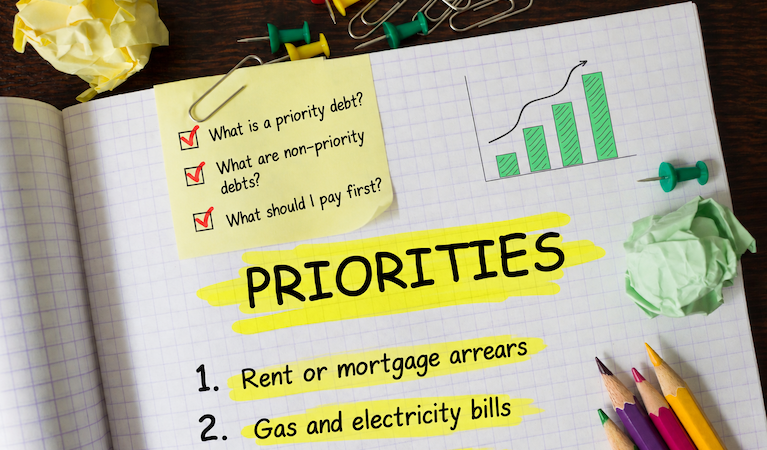
 Priority and Non-Priority Debts: What Should You Pay First?

